Jobless growth refers to a situation where economic growth does not translate into proportional employment generation. While this concern has often been raised in the Indian context, recent data and economic evidence increasingly challenge the narrative that India’s growth has been largely jobless.
India has witnessed significant employment growth over the years. With employment increasing by nearly 36%, adding around 170 million jobs during 2016-17 and 2022-23, India’s economic trajectory demonstrates sustained job creation across key sectors.
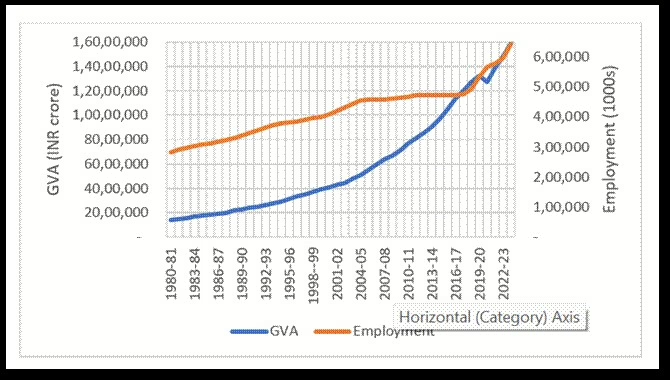
Employment trends in India over the Years to Present a Different Story
India’s Employment Growth: Contrary to the claims of “jobless growth,” data shows that employment in India increased by 36% (170 million jobs) between 2016-17 and 2022-23. During the same period, GDP grew at an average rate of over 6.5%.
KLEMS Database Consistency: Employment data from the Reserve Bank of India’s KLEMS database, which relies on surveys like the Employment and Unemployment Survey (EUS) and Periodic Labour Force Survey (PLFS), indicates a steady rise in employment since the 1980s.
Worker Population Ratio (WPR): The PLFS data from 2017 to 2025 also suggests that Worker Population Ratio (WPR) has increased by 10 percentage points
The overall Worker Population Ratio (WPR) in September 2025 was 52.4%, the highest level recorded since May 2025.
WPR was 34.7 in 2017-2018
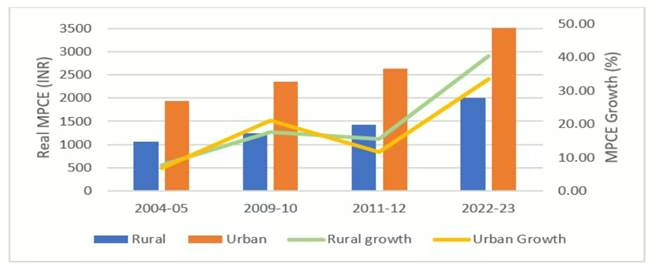
Consumption-Driven Growth: India’s growth has been driven by consumption, which is closely tied to employment. A rise in consumption implies that employment generation is occurring, as consumption would decline if employment were predominantly in unpaid or low-wage jobs
Economic Survey (2023-24) highlights significant improvements in employment and skill development. Key trends of Economic Survey include:
Sectoral Employment: Agriculture remains dominant, employing over 45% of the workforce, though there is a gradual shift toward manufacturing and services.
Female Workforce Participation: The female labor participation rate has steadily increased due to supportive policies.
Manufacturing Recovery: Factories employing over 100 workers experienced 11.8% growth between FY18 and FY22, indicating that larger industrial units are creating more jobs than smaller ones.
Wage Growth: During FY15-FY22, the wages per worker in rural areas grew at 6.9 per cent CAGR visà-vis a corresponding 6.1 per cent CAGR in urban areas. This growth reflects the rising demand for labor in rural industries such as construction and manufacturing, as well as public employment programs like Mahatma Gandhi National Rural Employment Guarantee Act (MGNREGA).
EPFO Payroll Growth: The yearly net payroll additions to the EPFO have more than doubled from 61.1 lakh in FY19 to 131.5 lakh in FY24, driven by new job creation and greater formalization of employment.
Gig Economy: India’s gig economy is expanding rapidly, with the workforce in this sector expected to grow to 2.35 crore by 2029-30.
Manufacturing and AI: The manufacturing sector remains shielded from automation, offering continued job growth opportunities.
Conclusion
Overall, the claim of jobless growth in India does not hold when examined against empirical evidence. Employment generation has continued across sectors, though often in informal and emerging forms. The real challenge before India is not the absence of jobs, but improving the quality, productivity, and formalisation of employment to ensure that economic growth leads to inclusive and sustainable livelihoods.
Sample UPSC Mains Question
Q.Despite rising education levels, Female Labour Force Participation in India remains low. Examine the causes.
At InclusiveIAS, our editorial team is led by experts who have successfully cleared multiple stages of the UPSC Civil Services Examination, including Mains and Interview. With deep insights into the demands of the exam, we focus on crafting content that is accurate, exam-relevant, and easy to grasp.
Whether it’s Polity, Current Affairs, GS papers, or Optional subjects, our notes are designed to:
Break down complex topics into simple, structured points
Align strictly with the UPSC syllabus and PYQ trends
Save your time by offering crisp yet comprehensive coverage
Help you score more with smart presentation, keywords, and examples
🟢 Every article, note, and test is not just written—but carefully edited to ensure it helps you study faster, revise better, and write answers like a topper.