SAARC – South Asian Association for Regional Cooperation | UPSC Notes

  • Home
  • SAARC – South Asian Association for Regional Cooperation | UPSC Notes
Shape Image One

South Asian Association for Regional Cooperation (SAARC)

  • SAARC is an economic and political regional organisation of countries in South Asia set up in 1985. 
  • It aims to accelerate the process of economic and social development in its member states through increased intra-regional cooperation.

Origin

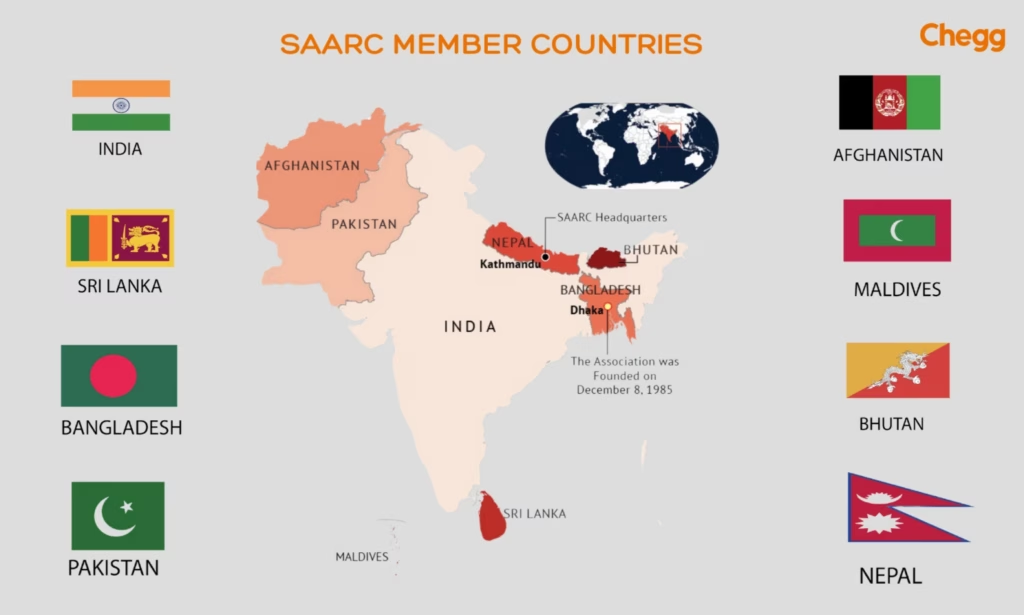
  • The South Asian Association for Regional Cooperation (SAARC) was established with the signing of the SAARC Charter in Dhaka on 8 December 1985.
  • The Secretariat of the Association was set up in Kathmandu on 17 January 1987.

Members

  • The eight member countries of SAARC (South Asian Association for Regional Cooperation) are Afghanistan, Bangladesh, Bhutan, India, Maldives, Nepal, Pakistan, and Sri Lanka
  • The seven founding members of the South Asian Association for Regional Cooperation (SAARC) are Bangladesh, Bhutan, India, the Maldives, Nepal, Pakistan, and Sri Lanka. 
    • Afghanistan later joined as the eighth member in 2007.

External Relations/Observers

  • There are currently nine Observers to SAARC, namely: (i) Australia; (ii) China; (iii) the European Union; (iv) Iran; (v) Japan; (vi) the Republic of Korea; (vii) Mauritius; (viii) Myanmar; and (ix) the United States of America.
  • There is a moratorium on the admission of new Observers to SAARC at present. Observers are invited to participate in the inaugural and closing Sessions of SAARC Summits.

Objectives

The objectives of the Association as outlined in the SAARC Charter are: 

  1. To  promote the welfare of the peoples of South Asia and to improve their quality of life 
  2. To  accelerate economic growth, social progress and cultural development in the region and to provide all individuals the opportunity to live in dignity and to realize their full potentials
  3. To  promote and strengthen collective self-reliance among the countries of South Asia
  4. To contribute to mutual trust, understanding and appreciation of one another’s problems
  5. To promote active collaboration and mutual assistance in the economic, social, cultural, technical and scientific fields
  6. To strengthen cooperation with other developing countries
  7. To strengthen cooperation among themselves in international forums on matters of common interests
  8. To cooperate with international and regional organizations with similar aims and purposes

Areas of Cooperation

  • Human Resource Development and Tourism
  • Agriculture and Rural Development
  • Environment, Natural Disasters and Biotechnology
  • Economic, Trade and Finance
  • Social Affairs
  • Information and Poverty Alleviation
  • Energy, Transport, Science and Technology
  • Education, Security and Culture and Others

Decision Making

Decisions at all levels are to be taken on the basis of unanimity; and bilateral and contentious issues are excluded from the deliberations of the Association.

Governance and Structure

SAARC Summit

  • The Meetings of the Heads of State or Government of Member States is the highest decision making authority under SAARC. 
  • Summits are usually held biennially hosted by a Member State in alphabetical order. 
  • The Member State hosting the Summit assumes the Chair of the Association.
  • The key outcome of a SAARC Summit is a Declaration.
  • The Summit Declaration contains decisions and directives of the Leaders to strengthen and consolidate regional cooperation in different areas being pursued under the auspices of SAARC.
  • The Declaration is adopted by the Leaders at the concluding session of a Summit.
  • The Summit also considers and approves reports of the Council of Ministers and Ministerial Meetings.
  • During the Summit, policy statements on regional cooperation under SAARC are made by the Leaders. 
  • The Summit is also addressed by Heads of Observer delegations and by the Secretary General.

Do you know?

The last SAARC summit was the 18th summit, held in Kathmandu, Nepal, from November 26–27, 2014. 

The planned 19th summit, which was to be held in Islamabad, Pakistan, in 2016, was canceled after several countries, including India, boycotted it following the Uri terrorist attack, which led to heightened tensions between India and Pakistan.

The first SAARC (South Asian Association for Regional Cooperation) summit was held in Dhaka, Bangladesh on December 7–8, 1985

Council of Ministers

  • Council of Ministers (CoM) comprises the Ministers of Foreign /External Affairs of the Member States. 
  • As per the Charter, the Council undertakes: 
    • Formulation of policies of the Association
    • Review of progress of cooperation under SAARC
    • Decision on new areas of cooperation
    • Establishment of additional mechanisms under SAARC, as deemed necessary
    • Decision on other matters of general interest to SAARC.
  • The Council meets, preceding the Summit and between the two summits. 
  • The Council reviews the progress of implementation of decisions taken by Summits. 
  • The reports of the Council of Ministers are submitted to the Meeting of Heads of State or Government for consideration/approval.
  •  The Council has also been meeting informally, since 1997, on the sidelines of the United Nations General Assembly Sessions in New York.

Standing Committee

  • The Standing Committee comprises the Foreign Secretaries of the SAARC Member States. 
  • As per SAARC Charter, they take measures /decisions relating to: 
    • Overall monitoring and coordination of programmes of cooperation under different areas
    • Approval of projects and programmes, including modalities of their financing
    • Determination of inter-sectoral priorities
    • Mobilisation of regional and external resources
    • Identification of new areas of cooperation based on appropriate studies.
  • The Standing Committee is mandated to meet as often as necessary. 
    • Generally, they have met preceding the sessions of the Council of Ministers i.e. both during the Summit as also as the Council is convened in between two Summits.
  • The Committee reports to the Council of Ministers, on regular matters and, as needed, asks for specific decisions on policy matters from the Council.

Secretariat

  • The SAARC Secretariat was established in Kathmandu on 16 January 1987. 
  • Its role is to coordinate and monitor the implementation of SAARC activities, service the meetings of the Association and serve as the channel of communication between SAARC and other international organizations.
  • Headed by Secretary General
    • Secretaries General of SAARC are appointed by the SAARC Council of Ministers upon nomination by a Member State in alphabetical order. They are appointed for a non-renewable term of three years.

SAARC Specialized Bodies

SAARC DEVELOPMENT FUND

  • Established in 2010
  • Secretariat is in Thimpu
  • The SAARC Development Fund (SDF) was officially established and inaugurated on April 28, 2010, by the Heads of States/Governments during the Sixteenth SAARC Summit in Thimphu, Bhutan.
  • It is  the umbrella regional financial institution for SAARC projects and programmes
  • SDF is dedicated to promoting regional integration and economic cooperation among the SAARC Member States through project funding and collaboration. 
  • The primary objective of SDF is to:
    • Promote the welfare of the people of SAARC region,
    • Improve their quality of life, and
    • Accelerate economic growth, social progress and poverty alleviation in the region.
      • To achieve these objectives, the SDF has the mandate to identify and finance projects, mobilize resources, and provide both financial and technical assistance, including comprehensive management of the Fund

    Origin

    • In 1996, the South Asian Development Fund (SADF) was created by merging earlier SAARC funds to support development projects.
    • The SADF was found inadequate in both funding and scope.
    • In 2005, SAARC financial experts recommended restructuring it into a single financing body.
    • At the 13th SAARC Summit (Dhaka, 2005), it was decided to reconstitute the SADF into the SAARC Development Fund (SDF).
    • The SDF was designed as an umbrella financial mechanism to support all SAARC projects and programs.

    South Asian University

    • Established in 2010
    • Located in New Delhi
    • The Agreement for the Establishment of South Asian University was signed by the Ministers of Foreign/External Affairs of the MSs of SAARC during the Fourteenth SAARC Summit (New Delhi, 4 April 2007).
    • Vision
      • enhance learning in the South Asian community that promotes an understanding of each others perspectives and strengthen regional consciousness;
      • provide liberal and humane education to the brightest and the most dedicated students of South Asia so that a new class of quality leadership is nurtured;
      • enhance capacity building of the South Asian Nations in science, technology and other areas of higher learning vital for improving their quality of life such as information technology, bio-technology and management sciences, etc.
    • Degrees and certificates awarded by the South Asian University are recognized by the University Grants Commission in India and by other SAARC countries. 
    • The University focuses overwhelmingly on research and post-graduate level programmes

    South Asian Regional Standards Organization (SARSO)

    • The fifteenth SAARC Summit paved the way for establishing SARSO in order to harmonize standards and promote cooperation in the fields of metrology, accreditation and conformity assessment for enhancing the capacity of the respective national institutions in carrying out their technical tasks. 
    • The agreement on SARSO came into effect on 25th August 2011.
    • The South Asian Regional Standards Organization (SARSO) is dedicated to promoting regional cooperation and integration through standardization, quality control, and certification of goods and services across South Asia.
    • SARSO’s mission is to harmonize standards, thereby facilitating trade, enhancing product safety, and promoting sustainable economic development within the region.

    SAARC Arbitration Council, Islamabad (SARCO) 

      • The agreement on SARCO was signed during the Thirteenth Summit, 2005, Dhaka, Bangladesh and came into effect on 2 July 2007. 
      • SARCO was established with a view to resolve cost-effective settlement of disputes via arbitration within the region.
      • It is an inter-governmental body mandated to provide a legal framework/forum within the region for fair and efficient settlement of commercial, industrial, trade, banking, investment, and such other disputes, as may be referred to by the member states and their people.
    • Objectives & Functions
      • Provide a legal framework within the region for fair and efficient settlement through conciliation and arbitration of commercial, investment, and such other disputes as may be referred to the Council by agreement;
      • Promote the growth and effective functioning of national arbitration institutions within the region;
      • Provide fair, inexpensive and expeditious arbitration in the region;
      • Promote international conciliation and arbitration in the region;
      • Provide facilities for conciliation and arbitration;
      • Act as a coordinating agency in the SAARC dispute resolution system;
      • Coordinate the activities of and assist existing institutions concerned with arbitration, particularly those in the region;
      • Render assistance in the conduct of ad hoc arbitration proceedings;
      • Assist in the enforcement of arbitral awards;
      • Carry out such other activities as are conducive or incidental to its functions.

    SAFTA

    • The Agreement on South Asian Free Trade Area (SAFTA) was signed at Islamabad during the Twelfth SAARC Summit on 6 January 2004
    • The agreement came into force in 2006, succeeding the 1993 SAARC Preferential Trading Arrangement. 
    • The South Asian Free Trade Area (SAFTA) is the free trade arrangement of the South Asian Association for Regional Cooperation (SAARC). 
    • SAFTA aims to enhance regional economic integration through preferential trade
    • SAFTA signatory countries are Afghanistan, Bangladesh, Bhutan, India, Maldives, Nepal, Pakistan and Sri Lanka.
    • SAFTA is a free trade agreement for goods
    • SAFTA recognizes the need for special and differential treatment for LDCs in its preamble.

    FAQs 

    Q1. What is SAARC?

    SAARC stands for South Asian Association for Regional Cooperation, a regional intergovernmental organization established in 1985 to promote economic and social development among South Asian nations.

    Q2. Which countries are members of SAARC?

    There are 8 members: Afghanistan, Bangladesh, Bhutan, India, Maldives, Nepal, Pakistan, and Sri Lanka. Afghanistan joined in 2007.

    Q3. What are the objectives of SAARC?

    SAARC aims to promote welfare, economic growth, social progress, cultural development, and collective self-reliance in South Asia.

    Q4. What is the decision-making process in SAARC?

    All decisions in SAARC are taken unanimously, and bilateral and contentious issues are excluded from its deliberations.

    ✍️ Curated by InclusiveIAS Editorial Team

    At InclusiveIAS, our editorial team is led by experts who have successfully cleared multiple stages of the UPSC Civil Services Examination, including Mains and Interview. With deep insights into the demands of the exam, we focus on crafting content that is accurate, exam-relevant, and easy to grasp.

    Whether it’s Polity, Current Affairs, GS papers, or Optional subjects, our notes are designed to:

    • Break down complex topics into simple, structured points

    • Align strictly with the UPSC syllabus and PYQ trends

    • Save your time by offering crisp yet comprehensive coverage

    • Help you score more with smart presentation, keywords, and examples

    🟢 Every article, note, and test is not just written—but carefully edited to ensure it helps you study faster, revise better, and write answers like a topper.

    Add Your Heading Text Here