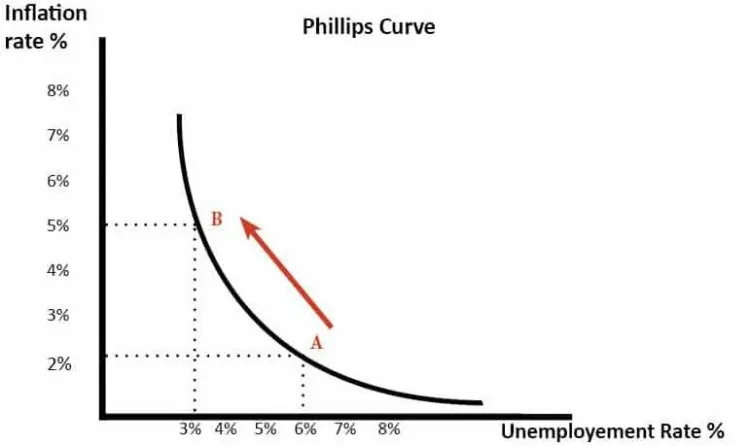
The Phillips Curve is an economic concept developed by A. W. Phillips. It describes a stable and inverse relationship between inflation and unemployment, suggesting that:
Higher inflation is associated with lower unemployment.
Lower inflation is associated with higher unemployment.
How It Works ?
According to this theory:
When unemployment falls, firms compete more for workers, pushing up wages.
Rising wages lead to increased costs for businesses, which are passed on as higher prices (inflation).
Economic growth thus tends to create more jobs and higher inflation.
Historical Context & Limitations
While the Phillips Curve was influential in policy debates, it lost credibility after the 1970s when economies experienced stagflation—a combination of high inflation and high unemployment.
This period showed that the relationship does not always hold in the long term.
Economists now consider the Phillips Curve to be more applicable in the short run, as expectations and other factors adjust over time.
Importance of the Phillips Curve
Policy Formulation Tool
The Phillips Curve has guided central banks in setting monetary policy, helping strike a balance between inflation control and employment generation.
Economic Forecasting
It serves as a predictive model. By analyzing past data, economists use it to anticipate trends in inflation and unemployment.
Understanding Inflation Dynamics
It links inflation with labor market slack, highlighting demand-pull inflation stemming from low unemployment.
Stabilizing the Economy
A sound understanding of the curve enables preemptive action against overheating or stagnation, promoting macroeconomic stability.
Limitations of the Phillips Curve
Empirically Driven and Context-Specific
The Phillips Curve is derived from empirical observations of historical data, and hence, its predictions may not always hold true for the future. Shifts in economic conditions—such as advancements in technology, globalization, or structural changes in the labour market—can significantly alter the relationship between inflation and unemployment, making the curve less reliable as a policy tool.
Neglect of Supply-Side Shocks
The Phillips Curve does not account for supply-side shocks, such as changes in the price of oil or other key commodities, which can have a significant impact on inflation and unemployment.
Assumes a Stable Trade-Off
The curve presumes a predictable inverse relationship, which was contradicted during stagflation in the 1970s and by expectations-augmented models later.
Hence, in practice, the relationship between inflation and unemployment can be highly variable and subject to external shocks, making it difficult to rely on the Phillips Curve for policy-making.
Not Universal
The Phillips Curve is not universally applicable, as it was originally derived from the UK’s economic data during the 1950s and 1960s. Different countries and historical periods, with their unique economic structures, labour markets, and policy frameworks, may exhibit varying relationships between inflation and unemployment, limiting the curve’s
The Phillips Curve remains a valuable conceptual tool in economics, particularly for understanding short-term trade-offs between inflation and unemployment. However, its limitations—especially in the face of supply shocks and inflation expectations—have prompted economists to refine it with adaptive models. While it is no longer a one-size-fits-all framework, it continues to inform monetary policy in conjunction with other macroeconomic indicators.
FAQs
Q1. What does the Phillips Curve show?
It shows an inverse relationship between inflation and unemployment in the short run.
Q2. Is the Phillips Curve still valid today?
Partially. In the short run, it may apply, but in the long run, it breaks down due to inflation expectations.
Q3. What caused the breakdown of the Phillips Curve?
Stagflation in the 1970s – simultaneous rise in inflation and unemployment.
At InclusiveIAS, our editorial team is led by experts who have successfully cleared multiple stages of the UPSC Civil Services Examination, including Mains and Interview. With deep insights into the demands of the exam, we focus on crafting content that is accurate, exam-relevant, and easy to grasp.
Whether it’s Polity, Current Affairs, GS papers, or Optional subjects, our notes are designed to:
Break down complex topics into simple, structured points
Align strictly with the UPSC syllabus and PYQ trends
Save your time by offering crisp yet comprehensive coverage
Help you score more with smart presentation, keywords, and examples
🟢 Every article, note, and test is not just written—but carefully edited to ensure it helps you study faster, revise better, and write answers like a topper.