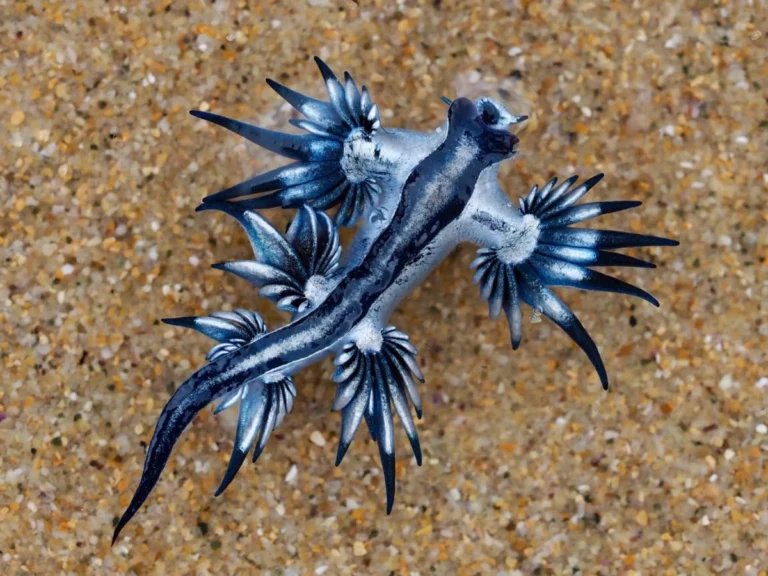
Blue Dragon (Glaucus atlanticus)

  • Home
  • Blue Dragon (Glaucus atlanticus)
Shape Image One

Blue Dragons

Context

Recently caused beach closures in Spain (Vivers, Santa Bárbara, Famara) due to mass strandings.
Introduction

  • Blue dragons are mollusks and belong to the nudibranch family, which means they are related to snails.
  • Blue dragons are a small type of sea slug (nudibranch).
  • Barely 4 cm long but capable of delivering a painful sting.

Features & Adaptations

  • Habitat: Blue dragons (Glaucus atlanticus) are a small type of sea slug that live on the ocean surface, drifting with the currents. 
  • While other sea slugs live on the seabed, blue dragons float upside down, like when we float on our backs. 
    • They can do so by swallowing and maintaining an air bubble in the stomach.
  • The marine creature floats with its underside facing upwards in the water for a reason. 
    •  It helps blue dragons “camouflage themselves with the sea’s blue colour
    • Camouflage:
      • Blue on the dorsal side → blends with sea from above.
      • White underside → blends with sunlight from below.
  • Diet: They feed on jellyfish and venomous siphonophores such as the Portuguese man o’ war, and incorporate the stinging cells of the jellies into multiple finger-like structures protruding from their bodies. This gives blue dragons a potent form of weapon against their predators.
    • Venom Storage: Incorporate stinging cells (nematocysts) from prey into finger-like appendages (cerata) → sting becomes more powerful than prey itself.
  • Also, the venom becomes concentrated in blue creatures, and their sting can be more powerful than that of the jellyfish they consume.

Impact on Humans

  • Sting is extremely painful, causing redness, swelling, nausea, vomiting.
  • Not fatal, but requires medical attention.

Distribution & Occurrence

  • Blue dragons occur in the warm tropical waters of the Pacific, Atlantic, and Indian oceans. In recent years, they have been cited farther afield, in countries such as Australia, South Africa, and the United States.
  • However, they have been rarely seen in the Mediterranean Sea.
    • First record – 1839, Canary Islands.
    • Sporadic sightings in the 20th century (Balearic Islands).

What led to the arrival of blue dragons in Spain?

  • Scientists suggest that the blue dragons’ arrival could be linked to rising Mediterranean temperatures, which brought more of their food sources, like the Portuguese man o’ war, into the region

Sea Slugs

Introduction

  • Sea slugs are marine gastropod molluscs.
  • Unlike land slugs or snails, they lack a protective shell in adulthood.
  • Known for their bright colours, striking patterns, and unusual adaptations.

General Features

  • Sea slugs have an enormous variation in body shape, color, and size. Most are partially translucent. 
  • Soft-bodied invertebrates with no external shell.
    • Most creatures known as sea slugs are gastropods, i.e. they are sea snails (marine gastropod mollusks) that, over evolutionary time, have either entirely lost their shells or have seemingly lost their shells due to having a significantly reduced or internal shell.
  • Sea slugs can be found from the shallow intertidal to the deep sea, and from the polar regions to the tropics.
  • Colouration: Bright colours serve as camouflage or warning signals to predators.
    • The color can warn other animals of the sea slug’s toxic stinging cells (nematocysts) or offensive taste
  • Respiration:Unlike land slugs, which use lungs to breathe, sea slugs breathe using their gills
    • Use exposed gill-like structures on their backs.
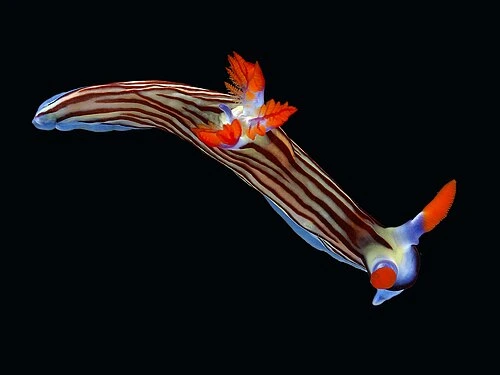
      • Ex: Nudibranch
  • Sea slugs have brains.
  • These slow-moving grazers consume algae, sponges, and other small invertebrates, showcasing a range of feeding habits.
  • They are usually found in coral reefs, and their presence is a significant indicator of a strong coral ecosystem
  • Some Sea Slugs can photosynthesise
    • When these sea slugs eat a certain type of algae they can photosynthesize their food from sunlight and oxygen, just like a plant, for about 10 days
  • Sea Slugs can regenerate body parts.
    • Some sea slugs can shed and regenerate their whole body
      • Sacoglossan sea slugs
  • Sea Slugs Steal the Defenses of Their Prey
    • Some aeolid nudibranchs (a type of sea slug) can steal the stings of the animals they eat. Creatures like jellyfish, sea anemones, and corals (from the Cnidaria phylum) use special stinging cells called cnidocytes on their tentacles to catch food. When aeolids eat them, they store these stinging cells in their own bodies and use them as a defense against predators.
  • Some sea slugs (like Tritonia exsulans) have neurons that react to magnetic fields, helping them orient themselves underwater.

FAQs 

Q1. What is a Blue Dragon?

A: The Blue Dragon (Glaucus atlanticus) is a small, vividly colored sea slug (nudibranch) that floats upside down on the ocean surface and delivers a painful sting.

Q2. Why are they called “blue dragons”?

A: Their striking blue color, dragon-like fingered appendages (cerata), and venomous capabilities earned them the name “blue dragons.”

Q3. How do Blue Dragons float?

A: Blue dragons swallow an air bubble and store it in their stomach, allowing them to float upside down at the ocean surface.

✍️ Curated by InclusiveIAS Editorial Team

At InclusiveIAS, our editorial team is led by experts who have successfully cleared multiple stages of the UPSC Civil Services Examination, including Mains and Interview. With deep insights into the demands of the exam, we focus on crafting content that is accurate, exam-relevant, and easy to grasp.

Whether it’s Polity, Current Affairs, GS papers, or Optional subjects, our notes are designed to:

  • Break down complex topics into simple, structured points

  • Align strictly with the UPSC syllabus and PYQ trends

  • Save your time by offering crisp yet comprehensive coverage

  • Help you score more with smart presentation, keywords, and examples

🟢 Every article, note, and test is not just written—but carefully edited to ensure it helps you study faster, revise better, and write answers like a topper.