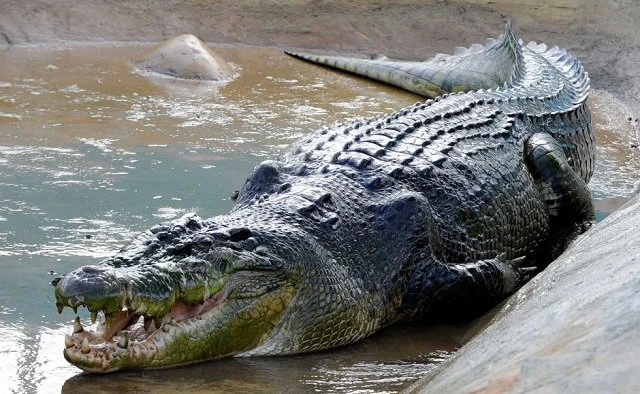
Saltwater Crocodile

  • Home
  • Saltwater Crocodile
Shape Image One

Saltwater Crocodile

Context

  • The estimated population of saltwater crocodiles, one of the largest reptiles in the world, has increased in the Sundarban Biosphere Reserve (SBR)
  • The population of saltwater or estuarine crocodiles (Crocodylus porosus) in and around Odisha’s Bhitarkanika National Park has marginally increased in 2024

Introduction

  • It is the largest living reptile in the world.
    • The saltwater is the largest of the 23 species of ‘extant’ or living crocodilians. This includes ‘true crocodiles’, alligators and caimans.
  • Apex predator, found in estuarine and coastal ecosystems.
  • Important both ecologically (keystone species) and culturally.
  • They are “hypercarnivorous apex predators” that keep flowing water ecosystems clean by feeding on the carcasses and wild remains in the water.

Behaviour & Ecology

  • Carnivore – feed on fish, birds, mammals, even sharks.
  • Territorial, especially adult males.
  • Nesting: Lays eggs in mud mounds; temperature determines sex of hatchlings 
  • They are highly territorial, with large male saltwater crocodiles often controlling extensive stretches of rivers, estuaries, or coastlines.
  • They are solitary creatures, especially when it comes to adult males.
  • Females are significantly smaller than the males
  • Saltwater crocodiles are among the most active of all crocodilians, spending more time cruising and active, especially in water. They are much less terrestrial than most species of crocodiles, spending less time on land except for basking.
  • Saltwater crocodiles are able to stay fully submerged underwater for long periods of time. To extend an aerobic dive, they can reduce their heart rate and oxygen consumption.

Crocodiles have very good night vision, and are mostly nocturnal hunters

Of the 24 species of crocodilian, 7 are currently listed as Critically Endangered, 4 as Vulnerable, 12 as Least Risk. 

The IUCN SSC Crocodile Specialist Group (CSG) is a worldwide network of biologists, wildlife managers, government officials, independent researchers, non – government (NGO) representatives, farmers, traders, tanners, fashion leaders, and private companies actively involved in the conservation of the world’s 23 living species of alligators, crocodiles, caimans and gharial in the wild

Distribution

  • Found in estuaries, mangroves, brackish waters, deltas, and coastal swamps.
  • The saltwater crocodile inhabits coastal brackish mangrove swamps, river deltas and freshwater rivers from India’s east coast, Sri Lanka and Bangladesh to Myanmar, Malaysia, Brunei, Indonesia, Philippines, Timor Leste, Palau, Solomon Islands, Singapore, Papua New Guinea, Vanuatu and Australia’s north coast
  • In India, saltwater crocodiles are distributed across the swamplands, rivers, mangroves of Odisha and West Bengal and the coastal areas of the Andaman and Nicobar Islands.
    • It is one of the three crocodiles native to the Indian Subcontinent, along with the mugger crocodile and the gharial

Conservation Status

  • IUCN: Least Concern
  • CITES: Appendix I (except the populations of Australia, Indonesia, and Papua New Guinea, which are included in Appendix II).
  • WPA, 1972: Schedule I

FAQs 

1. What is the conservation status of the saltwater crocodile?

IUCN Status: Least Concern

CITES: Appendix I (Appendix II in some regions)

WPA, 1972: Schedule I

2. Why are saltwater crocodiles called “keystone species”?

They regulate aquatic ecosystem health by preying on weak or dead animals, thus maintaining balance and water quality.

✍️ Curated by InclusiveIAS Editorial Team

At InclusiveIAS, our editorial team is led by experts who have successfully cleared multiple stages of the UPSC Civil Services Examination, including Mains and Interview. With deep insights into the demands of the exam, we focus on crafting content that is accurate, exam-relevant, and easy to grasp.

Whether it’s Polity, Current Affairs, GS papers, or Optional subjects, our notes are designed to:

  • Break down complex topics into simple, structured points

  • Align strictly with the UPSC syllabus and PYQ trends

  • Save your time by offering crisp yet comprehensive coverage

  • Help you score more with smart presentation, keywords, and examples

🟢 Every article, note, and test is not just written—but carefully edited to ensure it helps you study faster, revise better, and write answers like a topper.