


Economy
Monetary Policy Committee
The Monetary Policy Committee (MPC) is a six member statutory body constituted under the RBI Act, 1934. It determines the Policy Rate (Repo Rate) required to achieve the inflation target.
Legal Backing
- Constituted under Section 45ZB of the RBI Act, 1934 (amended in 2016).
- The first such MPC was constituted on September 29, 2016, replacing the earlier practice where the RBI Governor alone decided policy rates.
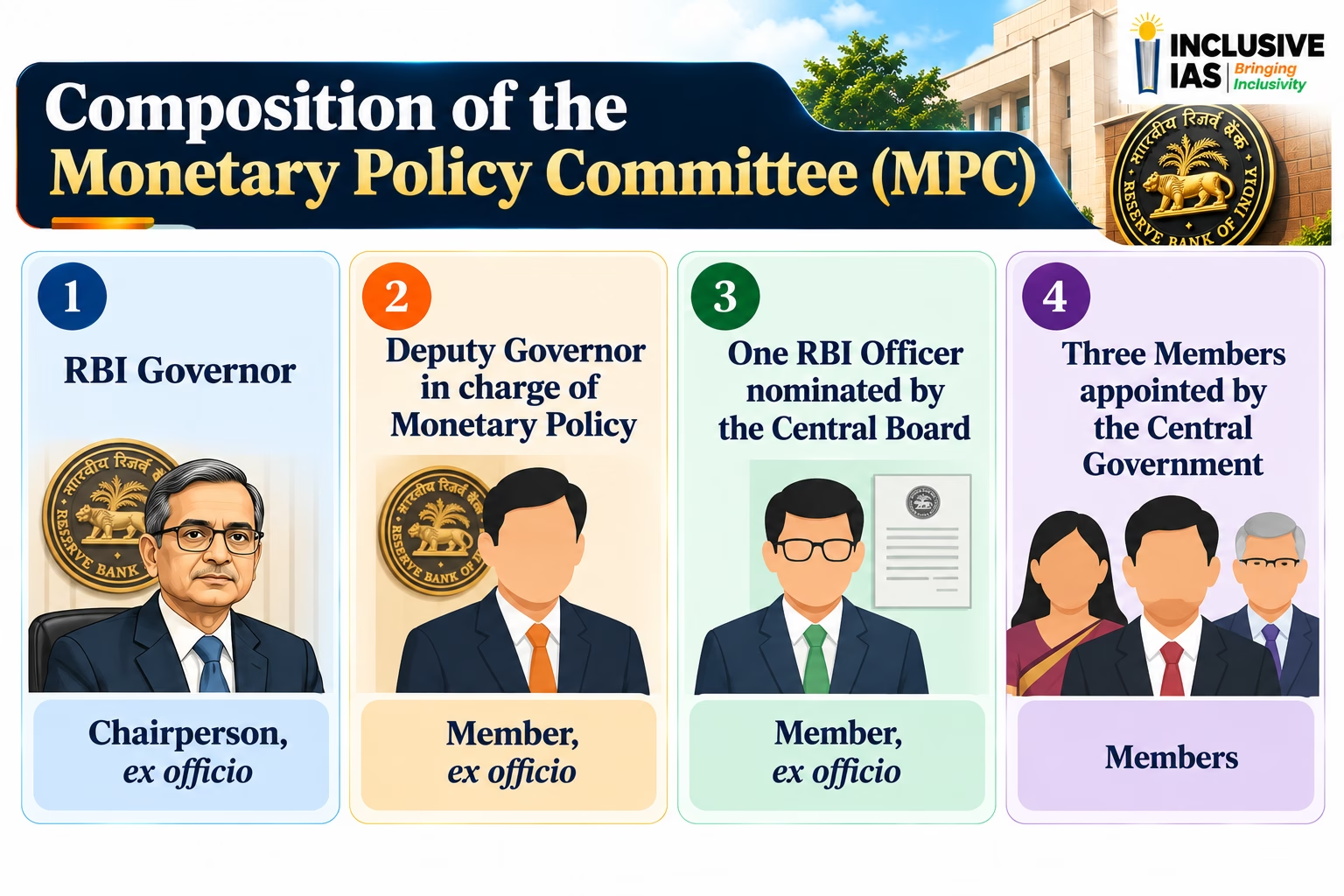
Composition of MPC (Total Members: 6)
- 3 from RBI:
- Governor of the Reserve Bank of India (Chairperson, ex officio)
- Deputy Governor of the Reserve Bank of India, in charge of Monetary Policy (Member, ex officio)
- One officer of the Reserve Bank of India to be nominated by the Central Board (Member, ex officio)
- 3 appointed by Government of India
- The three members of the MPC appointed by the Government of India hold office for a period of four years.
- None of the central government nominees are eligible to be re-appointed
Eligibility of Members Appointed by the Central Government
Under Section 45ZC of the RBI Act, 1934, the three members appointed by the Central Government must be persons of ability, integrity and standing, having knowledge and experience in Economics OR Banking OR Finance OR Monetary Policy
A person is not eligible for appointment if the person:
- Has completed 70 years of age on the date of appointment
- Is a member of any Board or Committee of RBI
- Is an employee of RBI
- Is a public servant
- Is a Member of Parliament or a State Legislature
- Has been adjudged insolvent
- Has been convicted of an offence punishable with imprisonment for 180 days or more
- Is physically or mentally incapable of discharging the duties of an MPC member
- Has a material conflict of interest with RBI that cannot be resolved
Selection of Government Appointed Members
The three members are appointed by the Central Government on the recommendation of a Search cum Selection Committee consisting of:
- Cabinet Secretary → Chairperson
- RBI Governor or his representative not below the rank of Deputy Governor → Member
- Secretary, Department of Economic Affairs → Member
Voting
- Each member has one vote.
- In case of a tie, the Governor has a second or casting vote.
Quorum
- The quorum for a meeting of the Monetary Policy Committee is four Members, at least one of whom shall be the Governor and in his absence, the Deputy Governor who is the Member of the Monetary Policy Committee.
Frequency of Meetings
- The MPC is required to meet at least four times in a year. (More meetings can be held if the RBI Governor is of that opinion)
Decision-making Process
- The decisions of the MPC are binding on the RBI.
Presiding Officer
- MPC meetings are presided over by the RBI Governor. In the Governor’s absence, the Deputy Governor who is a member of the MPC presides over the meeting.
Government’s Views
- The Central Government may, if it considers necessary, communicate its views in writing to the MPC from time to time.
Transparency Measures
- Minutes of MPC meetings are published 14 days after the meeting. The minutes contain:
- Resolution of the MPC: The resolution adopted by the Monetary Policy Committee at the meeting.
- Individual Votes: The vote of each MPC member on the resolutions adopted in the meeting, with each vote attributed to the member who cast it. It simply means that the voting choice of every MPC member is made public
- Individual Statements: The statement of each MPC member specifying the reasons for voting in favour of or against the resolution.
- In addition, subsequent to the MPC meeting, RBI has to publish a document explaining the steps to be taken by it to implement the decisions of the Monetary Policy Committee.
Significance of the Monetary Policy Committee (MPC)
- Democratization of Monetary Policy Decision-Making
- Replaces the earlier discretionary system where the RBI Governor solely decided policy rates.
- Introduces a collegial and consensus-driven approach, reducing arbitrariness.
- Each member has equal voting rights, ensuring diversity of opinion.
- Transparency and Accountability
- MPC’s decisions are published which enhances public trust and investor confidence.
- RBI must explain failures (if inflation breaches 2–6% band for 3 consecutive quarters).
- Anchoring Inflation Expectations
- Institutionalizes the Inflation Targeting (IT) Framework (currently 4% ±2% CPI).
- Helps businesses make rational financial decisions.
- Improves credibility of RBI, reducing the inflation-risk premium.
- Maintains Price Stability with Growth
- The MPC balances inflation control with the larger goal of economic growth.
- Supports the dual mandate: Price stability + Growth.
- In times of demand shocks or slowdowns, it can adopt expansionary policy.
- Rule-Based Framework
- Reduces discretionary power and enhances predictability of monetary policy.
- Acts within a defined legal mandate under the amended RBI Act, 1934.
- Improves India’s macroeconomic management framework in line with global standards.
- Strengthens Financial Market Stability
- Predictable and stable monetary policy improves:
- Bond market dynamics,
- Capital flows, and
- Exchange rate management.
- Helps maintain investor confidence (Domestic + Foreign).
- Predictable and stable monetary policy improves:
