
Home
Our Courses
Blog About Us Contact Us
New
Latest Articles
InclusiveIAS
NOTICE
📝 UPSC Mains 2026 Question Papers — all five papers now available with full PDFs: View All Papers 📝 UPSC Mains 2026 Question Papers — all five papers now available with full PDFs: View All Papers
📝 Download all UPSC Mains 2026 Question Papers

Fifth Schedule of the Indian Constitution: Provisions, Significance, Challenges and Reforms

  • Home
  • Fifth Schedule of the Indian Constitution: Provisions, Significance, Challenges and Reforms
Shape Image One

Fifth Schedule- Framework, Significance, Challenges and Way forward

The Fifth Schedule of the Indian Constitution represents India’s primary constitutional framework for the protection and governance of Scheduled Areas — territories characterised by significant tribal populations, geographic isolation, economic backwardness, and historical marginalisation that the framers recognised required special administrative arrangements distinct from the standard state governance framework. Unlike the Sixth Schedule’s elaborate institutional architecture of Autonomous District Councils with genuine legislative, judicial, and executive powers, the Fifth Schedule operates primarily through a protective and supervisory framework — giving Governors special powers, establishing Tribes Advisory Councils, and enabling the modification or exclusion of laws in Scheduled Areas — rather than creating separate autonomous institutions.
Constitutional Framework

  • Article 244(1) provides that the Fifth Schedule applies to the administration and control of Scheduled Areas and Scheduled Tribes in States other than Assam, Meghalaya, Tripura and Mizoram. 
    • Fifth Schedule areas are currently notified in Andhra Pradesh, Telangana, Chhattisgarh, Gujarat, Himachal Pradesh, Jharkhand, Madhya Pradesh, Maharashtra, Odisha and Rajasthan 
  • Declaration of Scheduled Areas 
    • The President of India is empowered to declare an area as a Scheduled Area.
    • He/she can:
      • Increase/decrease its area.
      • Alter its boundary lines.
      • Rescind such designation or make fresh orders for such redesignation on an area in consultation with the governor of the state concerned.
  • Executive Power of State and Centre
    • The state government’s executive power extends to Scheduled Areas.
    • However, the Governor has special responsibilities:
      • Must submit an annual (or as required) report to the President on the administration of these areas.
    • The executive power of the Centre extends to giving directions to the states regarding the administration of such areas. 
  • Tribes Advisory Council (TAC)
    • Every state having Scheduled Areas is required to establish a Tribes Advisory Council to advise the Governor on matters related to the welfare and advancement of Scheduled Tribes.
    • Tribes Advisory Council  comprises of not more than 20 members ,with three-fourths being representatives of Scheduled Tribes in the Legislative Assembly.
      • If the number of such ST representatives is insufficient, the remaining seats are filled by other members belonging to Scheduled Tribes
    • Tribes Advisory Council  advises on welfare and advancement of Scheduled Tribes.
    • It can also be formed in states without Scheduled Areas but having tribal populations, if directed by the President.
    • Powers of Governor with respect to Tribes Advisory Council (TAC):
      • The Governor can make rules regarding:
        • the number of members of the Council, the mode of their appointment and the appointment of the Chairman of the Council and of the officers and servants thereof;
        • the conduct of its meetings and its procedure in general; and
        • all other incidental matters
  • Law Applicable to Scheduled Areas
    • The Governor has wide legislative powers:
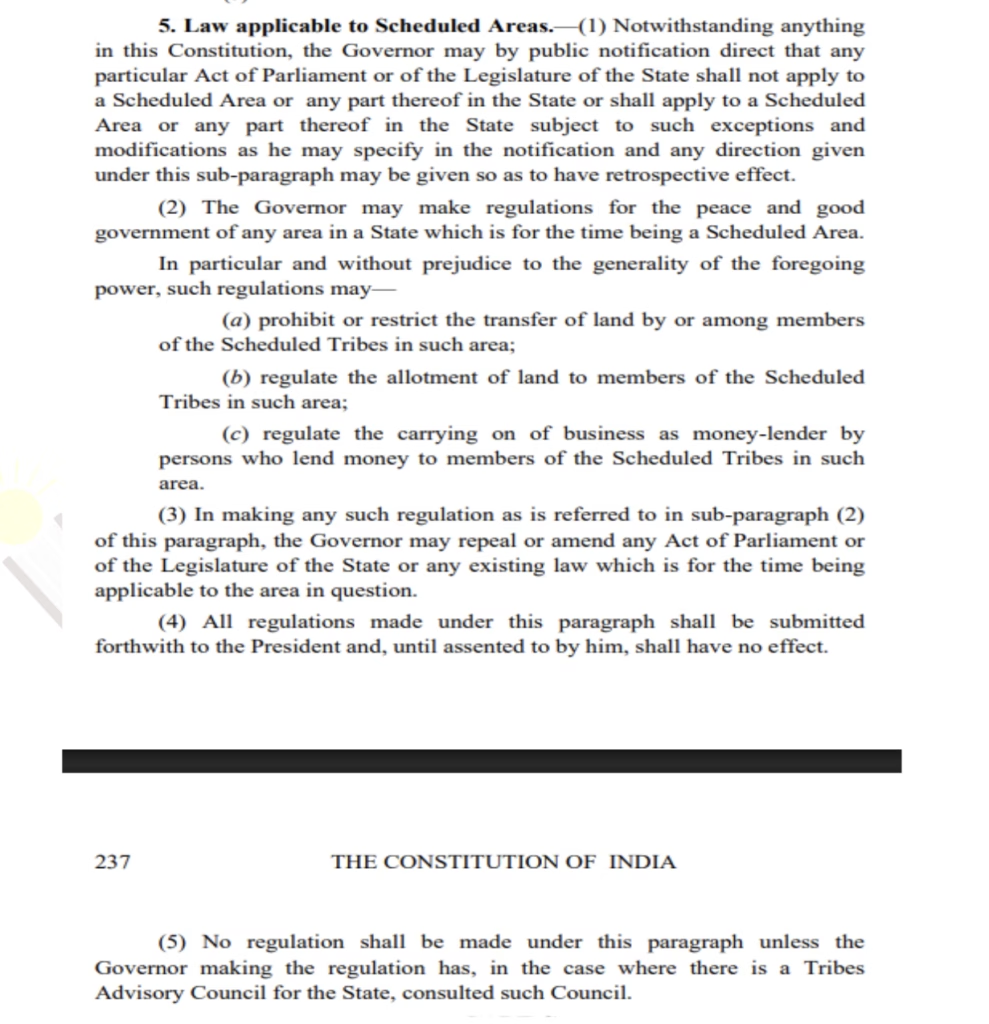
      • The Governor can exclude or modify the application of any Act of Parliament or State Legislature to Scheduled Areas.
      • The Governor can make regulations for the peace and good governance of the area after consulting the TAC.
        • These regulations can:
          • prohibit or restrict the transfer of land by or among members of the Scheduled Tribes in such area
          • regulate the allotment of land to members of the Scheduled Tribes in such area
          • regulate the carrying on of business as money-lender by persons who lend money to members of the Scheduled Tribes in such area.
      •  Also such regulations may repeal or amend any act of Parliament or the state legislature, which is applicable to a scheduled area.
      • But, all such regulations require the assent of the President.

Objectives of Scheduled Areas

  • Preserve tribal autonomy and culture.
  • Ensure social, economic, and political justice.
  • Prevent land alienation and exploitation.
  • Promote tribal welfare and development.

Relationship with PESA, 1996

  • Article 243M originally excluded Scheduled Areas from the automatic application of Part IX relating to Panchayats.
  • Parliament subsequently enacted the Provisions of the Panchayats (Extension to the Scheduled Areas) Act, 1996, or PESA, to extend Part IX with modifications suited to tribal communities.

Significance

  • Constitutional recognition of tribal distinctiveness 
    • The Fifth Schedule constitutionally acknowledges that tribal communities are not simply economically backward groups requiring poverty alleviation but distinct communities with unique identities, land relationships, customary legal systems, and governance traditions that deserve dedicated constitutional protection. 
  • Provides a Special Constitutional Framework for Tribal Administration 
    • The Fifth Schedule recognises that ordinary administrative arrangements are insufficient to address the distinctive social, economic and geographical conditions of tribal communities.
    • It establishes a differentiated system of administration while keeping Scheduled Areas within the constitutional and territorial framework of the concerned State.
  • Protects Tribal Land from Alienation 
    • Restrictions on land transfers protect tribal holdings from fraudulent transactions, indebtedness and acquisition by economically powerful outsiders. 
    • Paragraph 5(2) empowers the Governor to make regulations prohibiting or restricting the transfer of land by or among members of Scheduled Tribes and regulating the allotment of land to them. 
  • Protects Tribals from Exploitative Money-Lending 
    • Indebtedness and informal money-lending have historically contributed to the loss of tribal land and economic dependence.
    • Special regulation enables control over money-lenders operating in Scheduled Areas and protects tribal borrowers from exploitative practices.
      • Paragraph 5(2)(c) authorises regulations governing the business of persons who lend money to members of Scheduled Tribes 
  • Permits Adaptation of General Laws to Tribal Conditions 
    • Laws framed for the general population can adversely affect customary landholding, community resources and the social organisation of tribal communities.
    • The Fifth Schedule permits such laws to be excluded or modified before their application to Scheduled Areas.
      • Paragraph 5(1) empowers the Governor to direct that an Act of Parliament or the State Legislature shall not apply to a Scheduled Area or shall apply with specified exceptions and modifications. 
  • Gives Tribal Representatives an Institutional Voice 
    • The Tribes Advisory Council provides a constitutionally recognised platform through which tribal legislators can advise on matters affecting the welfare and advancement of Scheduled Tribes. 
    • The TAC’s constitutional mandate — with three-fourths of its members being tribal legislators — creates an institutional space for tribal voices to formally inform governance decisions affecting their communities. It represents an early constitutional attempt at participatory governance for marginalised communities. 
  • Promotes Tribal Welfare and Advancement 
    • It creates an institutional basis for improving the social and economic conditions of tribal communities. 
    • The Tribes Advisory Council can advise on welfare policies, protective legislation and developmental concerns referred to it. 
      • Paragraph 4(2) assigns the Tribes Advisory Council the duty of advising on matters relating to the welfare and advancement of Scheduled Tribes referred to it by the Governor. 
  • Governor’s special role as tribal protector 
    • The Governor’s extraordinary powers under the Fifth Schedule — to modify the application of laws, to make regulations for Scheduled Areas, and to report annually to the President — create a constitutionally mandated protective layer above the ordinary state government. The Governor functions not merely as the Centre’s representative but as a specific constitutional guardian of tribal interests. 
  • Framework for customary law recognition 
    • The Governor’s regulation-making power provides a constitutional basis for recognising and protecting tribal customary practices, traditional resource management systems, and community governance mechanisms 
  • Establishes Union Oversight over Scheduled-Area Administration 
    • Tribal administration is not treated solely as an internal responsibility of the State government.
    • The Governor’s reporting obligation enables the President and Union government to examine whether constitutional safeguards are being effectively implemented.
    • The Union can issue directions to the State regarding the administration of Scheduled Areas.
  • Promotes National Integration through Protection 
    • Constitutional protection reduces alienation arising from land loss, exploitation and administrative neglect.
    • The Fifth Schedule seeks to achieve integration through special protection and accommodation rather than administrative uniformity.
  • Promoting Substantive Equality and Distributive Justice 
    • The Fifth Schedule is an instrument to achieve substantive equality by correcting historical injustices 
    • It aligns with the Directive Principles of State Policy: 
    • Article 46: It fulfills the state’s obligation to promote the economic interests of Scheduled Tribes and protect them from all forms of social injustice and exploitation

Challenges/Issues

  • Protective Administration without Substantial Self-Government 
    • The Fifth Schedule protects tribal interests but does not create constitutionally empowered autonomous councils with legislative, executive and judicial authority.
    • Administration remains primarily under the State government and its departments.
  • Governor’s role reduced to formality 
    • The Governor’s special constitutional responsibilities under the Fifth Schedule have in practice been largely reduced to formal compliance rather than genuine protective intervention. Annual reports to the President are filed routinely without substantive review. The Governor’s power to modify laws for tribal protection has been used sparingly and inconsistently. 
      • Administrative Inertia of Governors: Governors often fail to use their discretionary powers independently, and their annual reports are frequently irregular, “stale narratives” of departmental programs that ignore crucial administrative issues 
  • Tribes Advisory Council rendered ineffective
    • The TAC, constitutionally mandated as the primary institutional voice for tribal interests, has functioned as a largely ceremonial body in most states. Meetings are infrequent, recommendations are non-binding, and the TAC is rarely consulted on significant decisions affecting tribal areas. 
      • The TAC lacks suo motu powers and often functions as a “rubber stamp” for the state executive rather than an autonomous body 
        • The Tribes Advisory Council can advise only on matters referred to it by the Governor.
          • It cannot constitutionally require the government to place every policy, law or project affecting tribal interests before it.
          • Its advice is not binding, while irregular meetings, limited research capacity and executive control over the agenda weaken its influence.
        • Lack of Independence: It has become a “state-run institution” because three-fourths of its members are from the State Legislature, and it is typically chaired by the Chief Minister 
  • Rampant land alienation despite constitutional protection 
    • Despite the Fifth Schedule’s land protection provisions, tribal land alienation has continued at scale across Scheduled Areas. Weak enforcement of land transfer restrictions, collusive land transactions, fraudulent documentation, and the conversion of agricultural land to non-agricultural purposes have enabled systematic dispossession that the constitutional framework was specifically designed to prevent. 
  • Mining and industrial displacement 
    • Tribal communities have been displaced by mining, dam construction, and industrial projects without the constitutional protections of the Fifth Schedule being effectively applied to their cases. 
  • Underutilisation of the Governor’s Special Powers 
    • Paragraph 5 gives the Governor extensive authority to exclude or modify general laws and frame regulations for Scheduled Areas.
    • These powers have not been used systematically to examine whether new laws relating to land, forests, minerals, markets and credit require adaptation to tribal conditions.
    • General laws are consequently extended to Scheduled Areas without a regular assessment of their effect on tribal landholding and social institutions.
  • Ambiguity in Scheduled Area declaration and extension 
    • The criteria for declaring and extending Scheduled Areas have been applied inconsistently. Many areas with significant tribal populations have not been declared Scheduled Areas, denying tribal communities the constitutional protections they would otherwise receive. The process of declaring new Scheduled Areas has been slow and opaque. 
      • There are numerous ST habitations across the country that are not notified as Scheduled Areas. These STs are denied the constitutional rights and empowerment under Article 244 and the provisions in various laws as are applicable to the Scheduled Area such as the Provisions of the Panchayats (Extension to Scheduled Area) Act 1996 (PESA) 
    • Outdated and Incomplete Scheduled Area Boundaries 
      • Scheduled Area notifications do not always correspond with present tribal settlement patterns.
      • Tribal-majority villages located outside historically notified blocks remain outside Fifth Schedule protection despite facing similar vulnerabilities.
  • State government resistance to tribal autonomy 
    • State governments have often resisted the genuine implementation of Fifth Schedule protections because tribal autonomy over land and resources conflicts with the state’s own developmental, revenue, and political interests. 
  • Urban-Governance Gap 
    • Article 243ZC excludes Scheduled Areas from the automatic operation of Part IXA relating to Municipalities.
    • Unlike PESA for rural areas, Parliament has not enacted a corresponding comprehensive law extending municipal governance to Scheduled Areas.

Way Forward

  • Strengthen the Tribes Advisory Council 
    • Representation should be ensured for women, PVTGs, smaller tribes, traditional institutions and persons with expertise in tribal law and administration. 
      • Legislative representation should remain central, but should not completely exclude communities lacking adequate representation in the State Assembly. 
    • All significant laws, policies and projects affecting Scheduled Tribes should be mandatorily referred to the Council.
    • The Council should be empowered to place matters on its own agenda rather than depend entirely upon gubernatorial reference.
    • Meetings should be held at prescribed intervals.
    • Reasons should be recorded where the government does not accept a significant recommendation.
  • Systematically Review the Application of Laws
    • Every new parliamentary and State law affecting land, forests, minerals, local government or customary institutions should undergo a Scheduled Area impact assessment.
    • The Governor should use Paragraph 5 powers where general legislation requires exclusions or modifications.
    • Decisions to apply a law without modification should also be based on a reasoned assessment rather than routine extension.
  • Reforming Scheduled Area declaration 
    • Clear, publicly disclosed, time-bound criteria for declaring new Scheduled Areas. 
    • A statutory review mechanism periodically assessing whether existing declarations adequately cover all areas with significant tribal populations. 
    • Independent assessment replacing the current opaque, politically influenced declaration process. 
  • Reinvigorating the Governor’s protective role 
    • The Governor’s Fifth Schedule responsibilities should be treated as active constitutional duties rather than ceremonial formalities. A dedicated tribal affairs secretariat within the Governor’s office, separate from the state government machinery, would enable genuinely independent assessment of Scheduled Area governance rather than dependence on state government reporting. 
  • Making Governor’s reports substantive and publicly accountable 
    • A uniform reporting framework should mandate state-wise information covering tribal land transfers and restoration, TAC functioning, use of special regulatory powers, displacement and rehabilitation, moneylending regulation, Article 275 expenditure, and health, education, and administrative outcomes in Scheduled Areas. 
    • Reports should incorporate TAC’s own views and specify action taken on TAC recommendations — ensuring the tribal voice is formally recorded within the accountability document. 
    • After Presidential consideration, both the report and a Union action-taken memorandum should be made publicly accessible 
  • Overhauling land protection enforcement 
    • Computerisation and public disclosure of all tribal land records in Scheduled Areas. Independent land audit mechanisms identifying alienated tribal land and initiating restoration proceedings. Strict criminal accountability for officials facilitating fraudulent land transactions in violation of Fifth Schedule protections. 
  • Independent monitoring mechanism 
    • Establishing a statutory Fifth Schedule Implementation Commission at the national level. The Commission would audit the Governor’s annual reports, review TAC functioning, assess land alienation trends, and report independently to Parliament — filling the complete absence of any systematic accountability mechanism for Schedule implementation.
  •  Addressing mining and displacement 
    • Mandatory Fifth Schedule compliance audit before any mining lease, infrastructure project, or industrial clearance in Scheduled Areas. 
    • The Governor’s modification power under Paragraph 3 should be actively used to ensure environmental and land acquisition laws are applied with tribal protective modifications in Scheduled Areas rather than in their standard form. 
  • Regulating moneylending effectively 
    • Digitising tribal credit records, expanding cooperative credit institutions in Scheduled Areas, and strictly enforcing existing moneylending regulations with dedicated tribal legal aid for debt recovery disputes. 
    • Addressing the structural economic vulnerability — rather than only regulating its symptoms — through livelihood and financial inclusion programmes specifically designed for Scheduled Areas. 
  • Evolving the framework for urban tribal populations 
    • Develop a specific governance framework for urbanising Scheduled Areas 
  • Use Paragraph 5 Powers Proactively
    • States should periodically review their land-transfer, tenancy and money-lending regulations to address new forms of exploitation.
    • Regulations should cover benami transactions, disguised leases, corporate arrangements, fraudulent records and indirect transfer of control.
  • Use Parliament’s Power to Modernise the Fifth Schedule 
    • Parliament should consider updating the Schedule to provide:
      • Mandatory periodic boundary review;
      • Stronger and more inclusive Tribes Advisory Councils;
      • Transparent Governor’s reports;
      • Regular review of applicable laws;
      • Minimum accountability standards;
      • Special arrangements for urbanising areas.

The Fifth Schedule represents the Constitution’s commitment to protect Scheduled Tribes from land alienation, economic exploitation, administrative neglect and cultural erosion through differentiated governance, special regulatory powers, tribal consultation and Union oversight. Its effectiveness, however, depends upon the active use of gubernatorial powers, meaningful functioning of Tribes Advisory Councils and timely review of Scheduled Areas. The objective must be to transform the Fifth Schedule from a framework of formal protection into an effective system of constitutional security, equitable development and preservation of tribal identity and dignity.

Sample Mains Question

  1. Explain the constitutional framework governing Scheduled Areas under the Fifth Schedule of the Indian Constitution. (10 Marks, 150 Words)
  2. Distinguish between the Fifth and Sixth Schedules of the Constitution in terms of administrative structure and tribal autonomy. (10 Marks, 150 Words)
  3. Examine the powers and responsibilities of the Governor under the Fifth Schedule. Why have these powers remained underutilised? (15 Marks, 250 Words)

✍️ Curated by InclusiveIAS Editorial Team

At InclusiveIAS, our editorial team is led by experts who have successfully cleared multiple stages of the UPSC Civil Services Examination, including Mains and Interview. With deep insights into the demands of the exam, we focus on crafting content that is accurate, exam-relevant, and easy to grasp.

Whether it’s Polity, Current Affairs, GS papers, or Optional subjects, our notes are designed to:

  • Break down complex topics into simple, structured points

  • Align strictly with the UPSC syllabus and PYQ trends

  • Save your time by offering crisp yet comprehensive coverage

  • Help you score more with smart presentation, keywords, and examples

🟢 Every article, note, and test is not just written—but carefully edited to ensure it helps you study faster, revise better, and write answers like a topper.