
Home
Our Courses
Blog About Us Contact Us
New
Latest Articles
InclusiveIAS
NOTICE
📝 UPSC Mains 2026 Question Papers — all five papers now available with full PDFs: View All Papers 📝 UPSC Mains 2026 Question Papers — all five papers now available with full PDFs: View All Papers
📝 Download all UPSC Mains 2026 Question Papers

Women’s Representation in Indian Judiciary: Status, Significance, Challenges and Way Forward

  • Home
  • Women’s Representation in Indian Judiciary: Status, Significance, Challenges and Way Forward
Shape Image One

Women’s Representation in Indian Judiciary

The Indian judiciary, despite being the constitutional guardian of equality and fundamental rights, remains one of the most visibly gender-skewed institutions in the country’s governance architecture. Women constitute a small minority of judges at the High Court and Supreme Court level, and an even smaller share in the highest leadership positions — Chief Justices and the Collegium itself. This underrepresentation is not merely a statistical anomaly but a structural failure with consequences for the quality, legitimacy, and lived experience of justice delivery in India.
Significance of Women’s Representation in Judiciary

  • Diversity of judicial perspective — women judges bring lived experience and sensitivity to cases involving gender-based violence, matrimonial disputes, workplace harassment, and reproductive rights — enriching the quality and contextual understanding of judicial reasoning
    • Improves Decision Making — Diversity improves decision-making by bringing multiple social perspectives into judicial reasoning. It prevents the judiciary from becoming socially narrow and elitist. 
  • Better adjudication of gender-sensitive laws — judges with a deeper, more empathetic understanding of women’s lived experiences are often better equipped to interpret laws on sexual harassment, domestic violence, and sexual offences with the sensitivity these cases require 
  • Strengthening institutional legitimacy/Representative Judiciary  — a judiciary that reflects the gender composition of the society it serves carries greater moral authority and public trust, particularly among women litigants who may otherwise feel alienated by an overwhelmingly male institution
    • A judiciary that reflects society enhances institutional legitimacy. Since women constitute nearly half of the population, their low representation weakens the inclusive character of the judiciary. 
  • Role modelling and aspirational impact — visible women judges, particularly in leadership positions, inspire greater participation of women in the legal profession from the entry level itself — law students, young advocates, lower judiciary aspirants
  • Improved access to justice for women litigants — presence of women judges and court staff can reduce intimidation and improve comfort for women approaching courts, particularly in sensitive cases (domestic violence, sexual offences)
  • Constitutional consistency — a judiciary actively interpreting and enforcing Articles 14, 15, and 16 must itself model the equality it adjudicates upon — institutional credibility is undermined when the interpreter of equality remains internally unequal
    • Improving Constitutional Morality — Articles 14, 15 and 16 uphold equality and non-discrimination. Better representation of women in judiciary strengthens the constitutional vision of substantive equality. 
  • Addressing Gender Bias in the Legal System — Women’s presence can help challenge patriarchal stereotypes in courtrooms, legal interpretation and institutional practices. 
  • Global commitments and benchmarking — India’s commitments under CEDAW and SDG 5 (gender equality) extend to representation in public institutions, including the judiciary

Current Status — Extent of Underrepresentation

  • Supreme Court — historically, only a handful of women have ever been appointed as Supreme Court judges since independence; India is yet to have a  women CJI across its entire judicial history
    • Justice B.V. Nagarathna is in line to become the first female Chief Justice of India in September 2027 
    • As of June 2026 — Out of 37 SC Judges, only two are women judges — Justice B.V. Nagarathna and Justice V. Mohana. This makes women’s representation around 5.4% in the Supreme Court
    • Since the establishment of the Supreme Court in 1950, women’s representation has remained extremely low. Justice Fathima Beevi became the first woman judge of the Supreme Court in 1989. Justice V. Mohana became the 12th woman judge of the Supreme Court. 
  • High Courts — women constitute a small minority of sitting High Court judges nationally, with significant variation across states — some High Courts having had very few or even no woman judges for extended periods
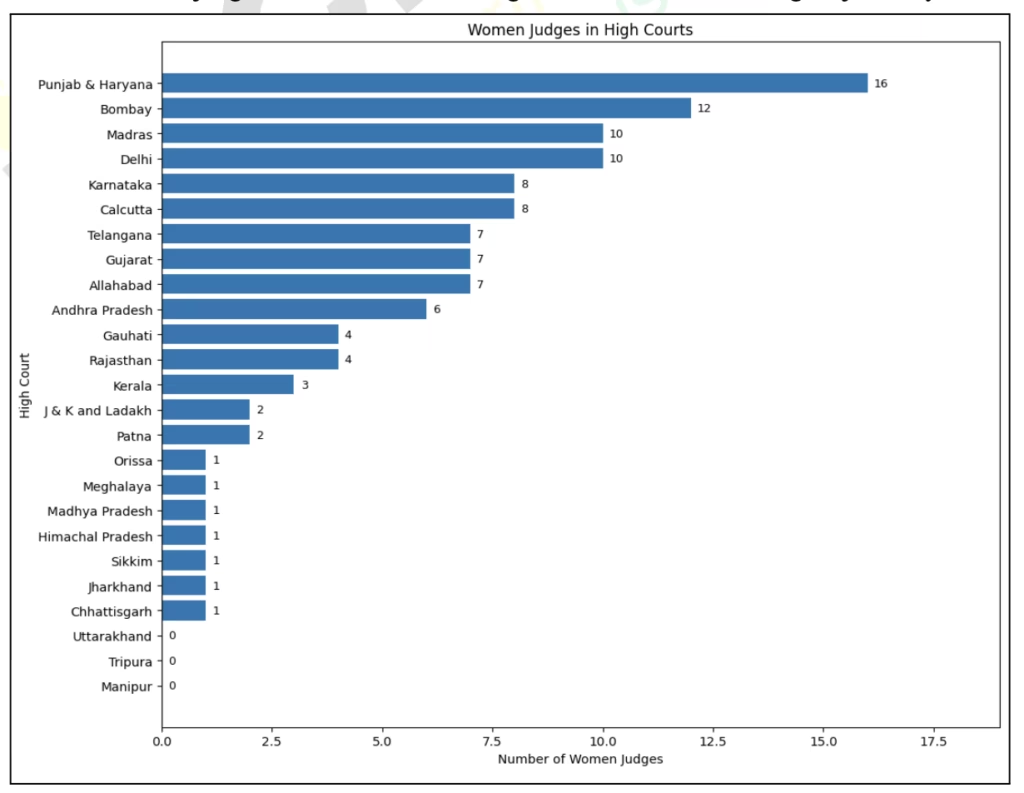
    • As per Lok Sabha data, against a total working strength of 803 judges across 25 High Courts, only 113 are women, amounting to nearly 14% representation. 
      • Women constitute only around 14% of working High Court judges. 
    • Some High Courts such as Punjab & Haryana, Bombay, Delhi and Madras have relatively better numbers, while High Courts like Manipur, Tripura and Uttarakhand have no woman judge. This reflects a serious gender imbalance in the higher judiciary.
  • Subordinate judiciary — representation is comparatively better at the lower judicial service level (district judiciary), particularly in states with reserved recruitment quotas, but this does not translate proportionately into higher judiciary appointments
    • Women Judges constitute ~35% of the Judges in the lower courts. Here the proportion varies from 19.5% in Gujarat to 70% in Goa.
    • As of 2025, 7,852 women judges serve in district and subordinate courts.
    • 17 of the 36 States and UTs had a smaller proportion of women in the lower judiciary than the national average.
  • Leadership positions — representation of women as Chief Justices of High Courts, and within the Collegium itself, remains negligible — meaning women are largely absent from the very body that decides on further judicial appointments

Reasons for Low Representation

  • Structural and Pipeline Issues
    • Narrow entry pool at senior advocate/designation level — higher judiciary appointments are often drawn from senior advocates and sitting judges — and women constitute a much smaller share of senior advocates designated by High Courts and the Supreme Court, narrowing the eligible pool from the outset
    • Attrition through the legal career pipeline — women enter law school and the legal profession in significant numbers, but attrition increases at each subsequent career stage — fewer women remain in active litigation practice long enough to accumulate the seniority and visibility required for judicial elevation
    • Limited representation in district judiciary promotions to High Courts — even where reserved recruitment improves women’s representation in subordinate judiciary, elevation pathways from district judiciary to High Courts remain narrow and competitive
  • Collegium System Constraints
    • Opaque, non-codified selection criteria — absence of transparent, objective selection criteria allows informal networks and existing biases to influence outcomes — disadvantaging women who may lack access to the same professional and personal networks as their male counterparts
    • Self-selecting, predominantly male Collegium — since the Collegium itself has historically had very few or no women members, decisions on future appointments are made by a body lacking gender diversity, potentially perpetuating existing patterns
    • Absence of mandatory diversity considerations — unlike some other countries, India’s judicial appointment process has no formal mandate or quota requiring consideration of gender diversity in higher judiciary appointments
      • South Africa — Its Constitution says that when judicial officers are appointed, the judiciary must broadly reflect the racial and gender composition of South Africa.
      • Belgium — The Constitutional Court has a legal requirement of gender balance: at least one-third of its judges must belong to the opposite sex  
  • Professional and Workplace Barriers
    • Career interruptions due to caregiving responsibilities — women advocates often face career breaks or reduced practice intensity due to maternity and family caregiving responsibilities, affecting continuity of visible, high-profile litigation experience valued in elevation decisions
    • Litigation practice culture — demanding, often unpredictable working hours in active litigation practice, combined with limited institutional support (childcare, flexible scheduling), disproportionately affects women’s ability to sustain the kind of high-visibility practice that leads to judicial consideration
    • Limited mentorship and sponsorship — women advocates often have fewer senior mentors and sponsors within the legal fraternity to advocate for their elevation, compared to the informal networks more readily available to male colleagues
  • Social and Cultural Factors
    • Persistent gender stereotypes about judicial temperament — lingering biases questioning whether women possess the requisite toughness or authority for judicial roles, particularly in criminal or politically sensitive matters
    • Family and social pressures — broader societal expectations regarding women’s familial roles can discourage sustained, decades-long commitment to demanding legal careers required for judicial elevation
    • Underrepresentation in bar associations and professional leadership — women remain underrepresented in bar council and bar association leadership roles, which often serve as informal stepping stones to recognition and elevation

Way Forward

  • Codifying transparent, diversity-conscious selection criteria — explicit consideration of gender diversity as one factor in Collegium deliberations, alongside merit and seniority, without compromising overall quality standards
  • Strengthening the pipeline through designation reform — reforming senior advocate designation processes to ensure women advocates are fairly considered and not systematically overlooked, widening the eligible pool for future judicial appointments
  • Mandatory or aspirational diversity targets — exploring time-bound, transparent targets for women’s representation in High Court and Supreme Court appointments, similar to mechanisms used in other public institutions
  • Improving institutional support for legal practice — childcare facilities at courts, flexible practice arrangements, and professional support structures to reduce career interruption penalties for women advocates
  • Structured mentorship and sponsorship programmes — formal mechanisms within bar associations and law firms to mentor and actively sponsor women advocates toward senior designation and judicial consideration
  • Greater representation of women within the Collegium itself — ensuring that as more women are elevated to the Supreme Court, they are also included in Collegium deliberations, creating a self-reinforcing improvement in diversity-conscious decision-making
  • Strengthening subordinate-to-higher judiciary elevation pathways — given relatively better gender representation in district judiciary, creating clearer, merit-based pathways for elevation from subordinate judiciary to High Courts
  • Addressing workplace culture in litigation practice — bar associations and senior advocates actively working to make litigation practice more sustainable for women, including addressing harassment and exclusionary professional networks
  • Public data transparency on representation — regular, disaggregated publication of gender representation data across all levels of judiciary, enabling accountability and tracking of progress over time

The underrepresentation of women in India’s judiciary reflects a structural paradox — an institution constitutionally entrusted with enforcing gender equality remains internally far from equal in its own composition. This is not simply a matter of optics but of substantive justice: a judiciary lacking diverse perspective risks adjudicating gender-sensitive matters with incomplete understanding, and risks alienating the very citizens, particularly women, it exists to serve. Addressing this requires interventions across the entire pipeline — from legal education and bar practice through to senior designation and Collegium deliberation — recognising that genuine representation cannot be achieved through appointment-stage fixes alone, but requires correcting the structural barriers women face at every preceding stage of a legal career.

“A judiciary that interprets equality for the nation cannot indefinitely remain an exception to it. Until the bench reflects the society it serves, justice itself remains only partially complete — correct in its judgments, perhaps, but incomplete in its perspective.”

Sample Mains Question

  1. Examine the current status of women’s representation in the Indian judiciary. Why does representation decline at the higher levels? (10 Marks, 150 Words)
  2. “The underrepresentation of women in the higher judiciary is not merely a numerical imbalance but a structural failure.” Discuss. (15 Marks, 250 Words)
  3. Analyse the significance of gender diversity for the quality and legitimacy of judicial decision-making. (15 Marks, 250 Words)

✍️ Curated by InclusiveIAS Editorial Team

At InclusiveIAS, our editorial team is led by experts who have successfully cleared multiple stages of the UPSC Civil Services Examination, including Mains and Interview. With deep insights into the demands of the exam, we focus on crafting content that is accurate, exam-relevant, and easy to grasp.

Whether it’s Polity, Current Affairs, GS papers, or Optional subjects, our notes are designed to:

  • Break down complex topics into simple, structured points

  • Align strictly with the UPSC syllabus and PYQ trends

  • Save your time by offering crisp yet comprehensive coverage

  • Help you score more with smart presentation, keywords, and examples

🟢 Every article, note, and test is not just written—but carefully edited to ensure it helps you study faster, revise better, and write answers like a topper.